Tempered Glass or Insulated Glass for a Door?

Foggy glass in a door, a feeling of cold near the entrance, or a cracked glass panel often raise the same question: tempered glass or insulated glass for a door—which is the right solution?
The answer depends less on choosing between two products and more on identifying the problem that needs to be corrected. Tempered glass is primarily designed for safety, while insulated glass focuses on thermal insulation. In many exterior doors, both technologies can actually be combined within the same glass panel.
Before replacing anything, it is important to identify the cause of the problem. A failed insulated glass unit does not automatically mean the entire door needs to be replaced. Likewise, damaged safety glass cannot be repaired with simple caulking.
A proper diagnosis helps avoid unnecessary expenses while restoring the door's comfort, appearance, and functionality.
Tempered Glass vs. Insulated Glass for a Door: Understanding the Difference
Tempered glass is a type of safety glass. It undergoes a heat-treatment process that makes it more resistant to impact than ordinary glass.
If it breaks, it typically shatters into small, less sharp pieces rather than forming long, dangerous shards.
This is why tempered glass is frequently used in areas exposed to impacts or human contact, particularly glass doors, panels near entrances, and patio doors.
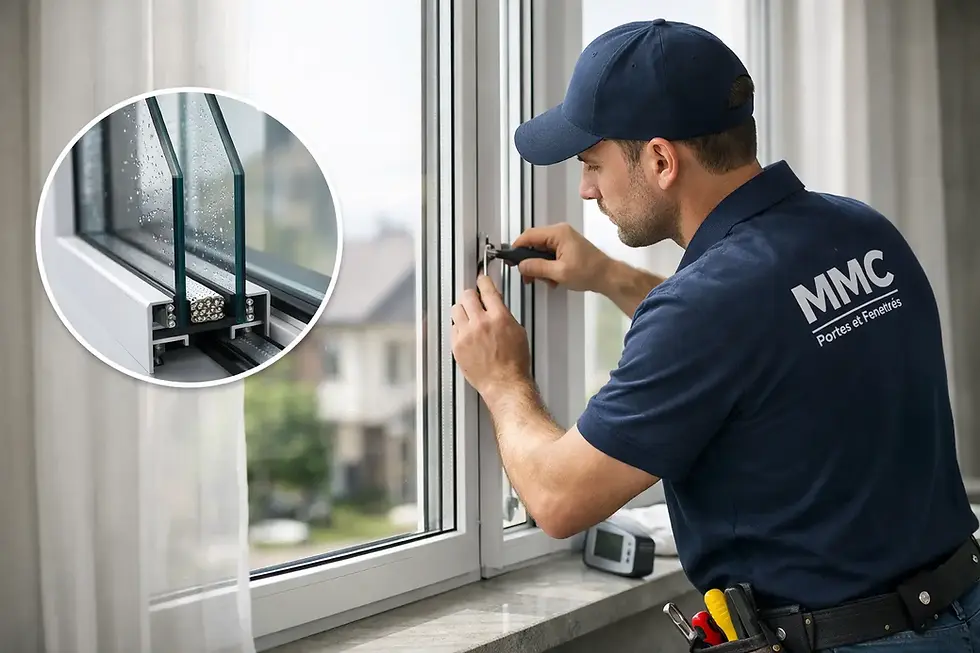
An insulated glass unit (IGU), also called a sealed glass unit or thermos, consists of two panes of glass separated by a sealed space. This space contains dry air or an insulating gas.
Its purpose is to limit heat transfer and reduce condensation on the interior surface of the glass.
An insulated glass unit can be manufactured using tempered glass, but it may also contain other types of glass depending on the intended application and the dimensions of the panel.
In other words, comparing tempered glass and insulated glass as though you must choose one or the other is not always accurate.
An exterior door may contain an insulated glass unit in which one or both panes are tempered, combining safety with energy efficiency.
When Is Tempered Glass Necessary?
Tempered glass is generally preferred when safety is a concern.
A door with a large glass panel, a patio door, or a glass sidelight near an entrance is more exposed to accidental impacts from balls, moving objects, strong winds, or everyday contact.
In these situations, how the glass behaves when it breaks is just as important as its resistance to impact.
It is also important to understand that tempered glass cannot be modified after manufacturing.
It cannot be cut, drilled, or adjusted on-site without causing it to break.
If the glass is cracked, chipped along its edges, or completely broken, it must be replaced with a properly sized panel designed for that specific application.
Tempered glass breakage can be dramatic. The panel may suddenly shatter into numerous small fragments.
This can happen following an impact, but also when an edge has been damaged or subjected to stress.
It is important not to immediately assume that the door itself is defective.
Examining the glass, frame, and supporting blocks helps determine what caused the breakage.
When Should You Replace an Insulated Glass Unit in a Door?
The clearest sign of a failed insulated glass unit is condensation trapped between the two panes of glass.
This condensation cannot be wiped away because it forms inside the sealed unit.
It may appear as a cloudy white film, small water droplets, or permanent marks that reduce visibility.
When the seal is compromised, humid air enters the insulating space.
The glass then loses some of its thermal performance and visual clarity.
During winter, you may notice a colder area near the door. During summer, the glass may allow more heat to enter your home.
Although this is not always an emergency, the problem will not resolve itself.
Replacing the insulated glass unit is often a more practical solution than replacing the entire door, provided the frame, threshold, weatherstripping, and hardware are still in good condition.
This allows you to keep your existing door while correcting the actual source of discomfort.
It is a targeted repair that avoids discarding components that are still functional.
Signs to Look for Before Making a Decision
Condensation between the panes generally indicates a failed seal.
However, condensation on the interior surface of the glass may also be caused by excessive humidity inside the home, limited air circulation, or a significant temperature difference.
These two situations may look similar, but they require different solutions.
A cold draft does not necessarily come from the insulated glass unit.
The door weatherstripping may be compressed, hardened, or detached.
The door may also be improperly adjusted, preventing even pressure against the seals.
In this situation, replacing the glass alone will not completely solve the problem.
Checking the door's weather resistance and alignment is essential.
Finally, a crack, impact mark, or chip in the glass requires prompt attention, particularly when safety glass is involved.
Even if the panel still appears stable, damage along its edges can eventually lead to complete breakage.
It is better to secure the area and have the glass evaluated rather than wait for it to break unexpectedly.
The Right Choice Also Depends on the Type of Door
A glass entrance door and a patio door are exposed to different conditions.
An entrance door is often subjected to significant temperature changes and frequent use.
A patio door combines a large glass surface with the repeated operation of a sliding mechanism.
In both cases, the replacement glass must be compatible with the existing frame and the door's intended use.
The size of the glass panel is also important.
A large panel requires appropriate manufacturing specifications to remain stable, energy-efficient, and safe.
The type of spacer, glass thickness, choice of energy-efficient glass, and use of tempered glass are not merely decorative details.
These factors influence indoor comfort and the lifespan of the insulated glass unit.
This is also why a universal solution is rarely the best choice.
A standard insulated glass unit may be suitable for a small opening, while a larger exposed panel or one located in a high-traffic area may require a different glass configuration.
The best replacement is one that meets the specific requirements of the door without creating unnecessary work.
Repair Smart Before Replacing More Than Necessary
For homeowners on Montreal's North Shore, in Laval, or throughout Montreal, repairing an existing door is often a cost-effective decision.
If the problem is limited to the insulated glass unit, weatherstripping, hardware, or an adjustment, a specialized repair can extend the useful life of the door for several years.
At MMC Portes et Fenêtres, we assess the actual condition of the door and its glass to recommend the appropriate repair rather than a more expensive replacement that may not be necessary.
This approach allows us to preserve components that are still in good condition, replace defective parts, and improve comfort without changing the appearance of your home.
If your door has condensation between the panes, broken glass, or poor sealing, do not rely solely on the appearance of the problem.
A targeted assessment will help determine whether you need tempered glass, an insulated glass unit, or an additional repair to restore a reliable, safe, and comfortable door.
Need Help With Your Door Glass?
Does your entrance door or patio door have foggy, cracked, or damaged glass? Are you unsure whether you need to replace the tempered glass, the insulated glass unit, or even the entire door?
At MMC Portes et Fenêtres, we help identify the source of the problem and find the solution best suited to your situation.
Why replace an entire door when only the defective glass may need to be replaced?
We provide our services in Montreal, Laval, Montreal's North Shore, and surrounding areas.
Contact us today to request a quote.
MMC Portes et Fenêtres – We repair rather than replace!


Comments